
Super Intelligence Meets Trading


The opportunity
The goal of crypto is to democratise access to wealth creation. It’s why I’m here. It’s what I believe in.But wealth creation is gated. Most of crypto focuses on the first gate: access. Anyone with an internet connection can trade, 24/7, permissionlessly. We’re focused on this too, as we expand the markets and instruments available to users on Reya and continuously grow into an ‘everything exchange’. There is so much more to do here, I could write a post just on this.However, today, we’re announcing how we’re solving the second gate. The gate nobody wants to talk about. The gate that must be solved to actually democratise access to wealth creation: intelligence.Not IQ. Intelligence that can convert information into trades, with discipline, 24/7. Super intelligence. This is what a hedge fund does - it’s a machine that deterministically converts information into action. To date, a normal trader has been someone trading against that intelligent machine. Our goal: to level the playing field between professional firms and everyone else. And in time, we believe it will become so powerful even the professional firms will use it too.Uniquely, we're building this inside the exchange. That gives users long-term advantages that can't be replicated anywhere else - above all the latency of the agentic trading system, allowing agents to exist on the hotpath, and onchain safeguards around what the agent can and cannot do.
Understanding agentic trading: a simple framework
The question isn't whether agents will trade. It's how much authority to give them and when. The best articulation of the design space here is through a simple framework with five levels.
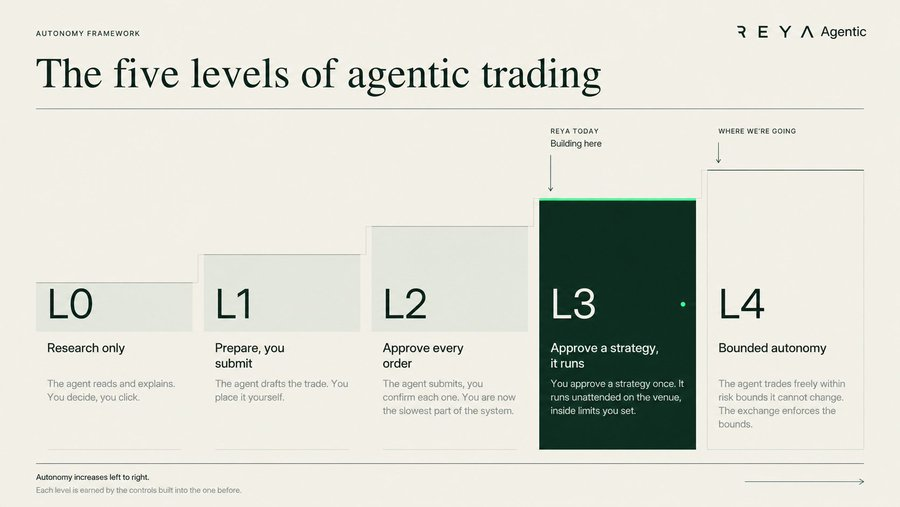
Level | What happens | Who decides the trade | Limits enforced by | What being inside the exchange adds |
|---|---|---|---|---|
L0: Research | The agent reads, summarises, explains | You | — | Venue-only data: liquidations, open interest, funding history, risk-engine state. For a transparent permissionless DEX these are negligible. |
L1: Prepare | The agent drafts size, price, stops; you place the trade. | You | What you place into the app. | Nothing an agentic trading product outside the DEX can't do. |
L2: Approve every order | The agent submits; you confirm each one | You, one tap at a time | A confirmation prompt – you are the slowest moving part of the system. | Marginal UX benefits by being inside the exchange. |
L3: Approve a deterministic strategy | You approve a strategy once; it runs unattended inside your limits. Available data material expands the scope of strategies you can deploy. | The strategy you approved. | Rules + caps, enforced by settable parameters inside onchain 'Agentic Accounts'. | Agentic accounts built into the exchange allow for settable safety parameters that can be enforced onchain (e.g. max loss). Co-hosting of strategies alongside the exchange lets strategies run 24/7 unattended whilst improving execution latency for users. |
L4: Bounded autonomy | The agent trades freely within risk bounds it cannot change. | The agent | Rules + caps, enforced by settable parameters inside onchain 'Agentic Accounts'. | The agent on the hotpath: state freshness, execution latency, decision latency of agent as this improves, allows for competitive decision making and execution against low latency firms. |
This design space gets super interesting at Level 3 onwards. Today Reya is Level 3, we will be here for some time as we improve the functionality, data and marketplace for users deploying agents to trade on Reya.Level 4 is the part I’m most excited about: agents on the hotpath making trade decisions on your behalf. The models aren’t good enough for this yet, in part because they’re too slow. But the pace of progress is so rapid, I think we’ll cross this threshold in the next 6 months. When we do, even the professional trading firms will start deploying agents on the hotpath of trade execution.
Where Reya is today: Level 3
Today, we’re launching the first agentic trading feature on Reya. This has already been through periods of testing with a subset of our hardcore users, so we’ve validated the value and the safety features built into it. We’re shipping value iteratively, with an exciting roadmap of features that will be added in the months ahead.Launching today you can do the following:
- Build, test, paper trade and deploy agent driven strategies 24/7: describe what you want to do and the agent turns it into a deterministic strategy you can read. Paper trading is available for those that want to test strategies before they deploy them. Then, when a strategy is approved, it runs 24/7 on the venue, reacting to live events and triggering buy/sell orders as determined in the strategy itself. You can stop the strategy at any time, audit every action taken and monitor the PnL of the strategy.
- Create “Agentic Accounts”: all agentic trading is done in a new type of sub-account we call an ‘Agentic Account’. Agentic Accounts have additional safeguards within them: the agent can’t deposit or withdraw. There are also settable parameters on maximum loss within a window, at which point the strategy will close all open positions and stop, alongside other parameters you can set yourself with the agent.
- Execute through an in-dapp chat or via RPC: onboarding in the dapp takes seconds, making your UX simple and straightforward. If you wish to operate ‘external’ agents in your own environment (e.g. Codex) you can use our agentic trading toolkit to build test and deploy strategies too.
Some example trades we’ve seen from our early testers:
"If ETH hits $2k, place a $10k long and a $50k BTC long too."
"Build me a TWAP that buys $20 of ETH exposure every 15 mins until I have $10k whilst simultaneously building $20 of SOL short exposure every 15 mins until I have $5k."
"Create a trailing stop that follows my ETH long 3% below its highest price, and closes it if ETH falls that far."
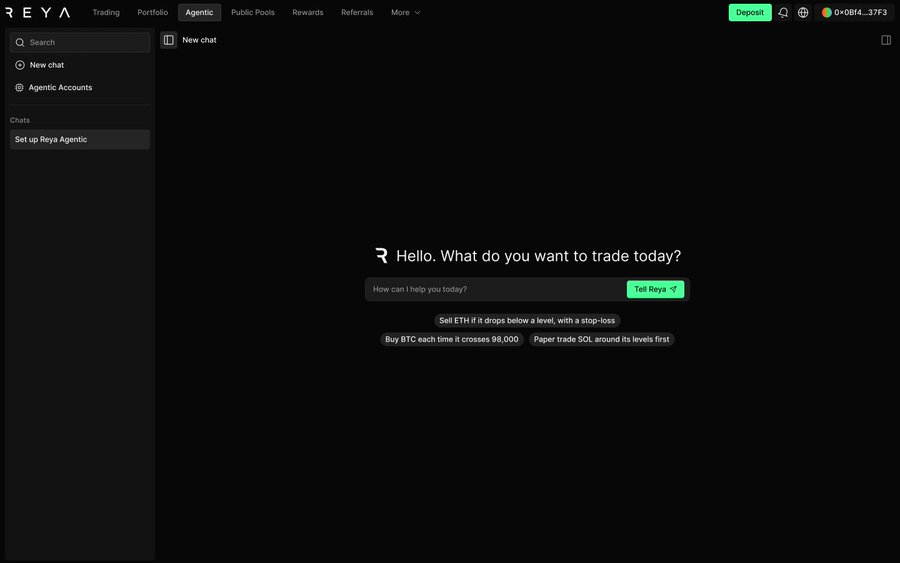
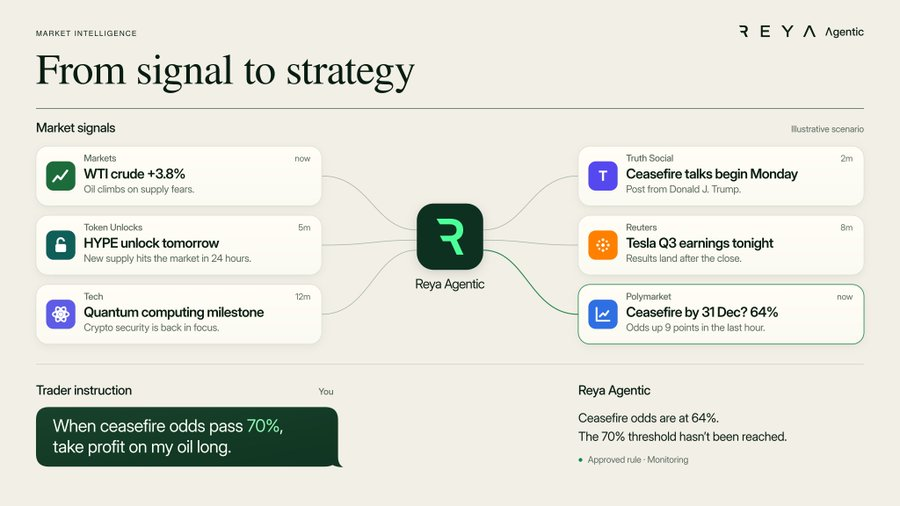
In the words of one of our early testers “I have been going hard writing agentic bots for reya. Crazy stuff. What a time to be alive.”From a roadmap perspective - we’ll be at Level 3 for a while as we keep improving the functionality of the product.One big area of the roadmap coming up: expanding the data available to the agent. Right now, the available data for building strategies is all coming from the exchange itself. Expanding this, and creating a data marketplace for users, will allow strategies to be built that react to tweets, sentiment, or other venue pricing. When live, you could Tell Reya
“If Twitter sentiment turns bullish, TWAP into BTC, $10k every 5 minutes until I hit $1m exposure"
Where we're heading and why it’s uniquely differentiated built into the exchange: Level 4
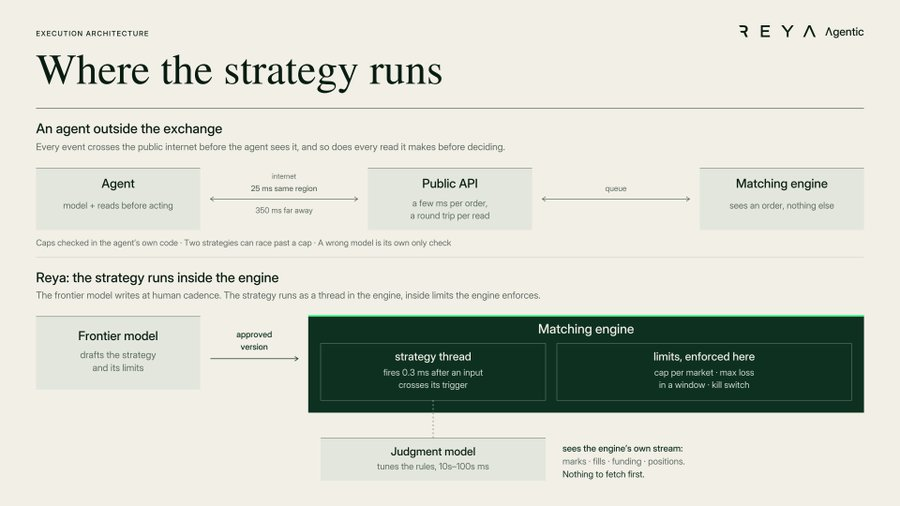
Level 3 allows you to do things you’ve never done before. However, it is fundamentally deterministic, so if market conditions change you may find a strategy you have running needs adjusting. To go further, the agent needs to be able to adjust on it’s own.The moment you say that, two questions follow. Can an agent keep up with the pace of the market and professional participants within it? And what stops it from blowing up the account? It’s these two points that can be solved when building agentic trading into the exchange.1. Time to thinkTo level the playing field between professionals and normal users you have to think about latency. A professional firm operating on Reya will try co-locate, to minimise the time it takes to send trades across the internet. Even in this scenario, latency still exists.However, our Agentic Trading product runs strategies inside the matching engine as it’s own thread. A rule that lives there fires about 0.3 ms after the an input (e.g. mark) crosses its trigger. It sees the same event stream the engine does, so there’s nothing to fetch first assuming the runtime acts based on the data that’s internal to Reya. When an event occurs on Reya, the book moves within tens of milliseconds as everyone else reacts. That window, between the event and the market having already repriced on it, is the agent’s budget.What you can do in that time varies depending on the type of model being deployed:
- A fixed rule: microseconds. “If funding is below Y and the mark crosses X, buy.” That’s Level 3.
- A small trained model, a tree or a tiny network that scores one set of inputs: about a millisecond. Professional firms have had these on the hot path for years.
- A judgment model: tens to hundreds of milliseconds. A new type of model built to answer a typed question, yes or no, which of these, a score, and say how confident it is. It doesn’t write text. The first one shipped this autumn: TypeSafe’s Jev answers in 70 to 500 ms by their own numbers.
- A frontier model: seconds, minutes if it reasons. It understands what you want, drafts the strategy and its limits, and explains decisions in plain English. Far too slow to be on the hot path.
So you may read this and go ‘the agents aren’t fast enough’. Yes that’s right. But they’re not fast enough today.Level 4 is not building for today, it’s building for the future when judgement models are fast enough. That future will be here sooner than you may think, and when it arrives we believe even the professional firms will be using it.
2. Can’t be evil > Don’t be evilWith agents making trade decisions safety becomes more important than ever. This is where an agentic trading product built into the exchange wins over a product built outside the exchange. Why? Because Agentic Accounts have safeguards that are enforceable onchain.It’s how the two worlds of AI and onchain trading can meet. AI is, by design, not deterministic. But that has side effects when building a trading strategy where you want deterministic controls around risk. Sure you can build something around the agent yourself, but allowing those safeguards to exist at the account level of the exchange, enforced onchain, provides a level of security not possible elsewhere.Agentic Accounts on Reya have safeguards today such as maximum losses within a given window. As the product capabilities expand, these setable parameters will expand. Effectively giving you risk controls around an agent-deployed strategy.Before long, agents will be watching every market you care about, sizing by your margin, stepping aside before a macro print, and explaining every decision. The bet isn’t on returns. Nobody honest can promise those. The bet is on capability, and on the controls that make it safe to hand over. When agents reach the hot path, the question for every trader becomes: which venue was built for that?
How you can get involved
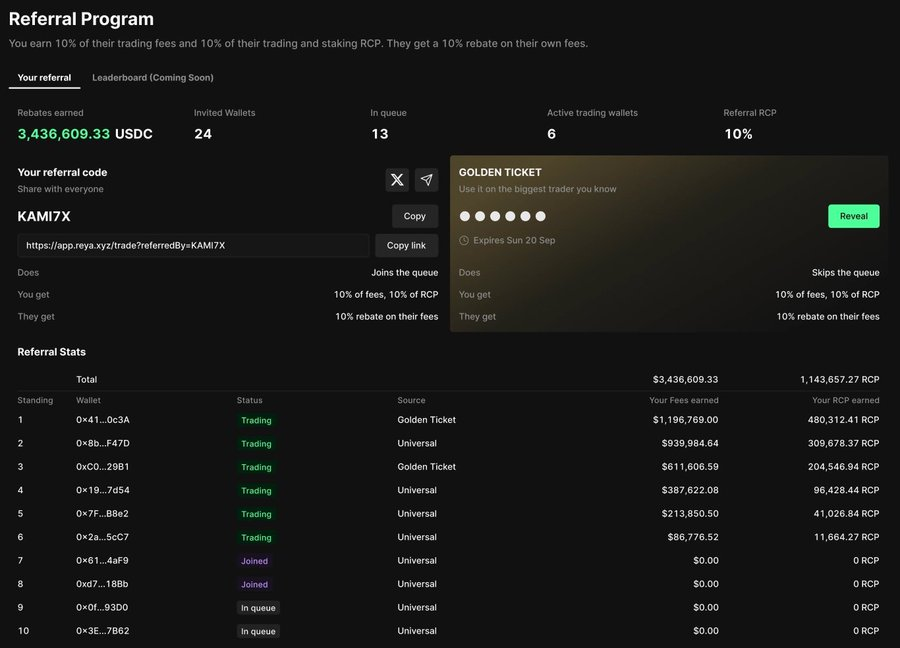
Agentic trading is now live for a small group of users who have access to the dapp. These are real users, trading real money with their own strategies. It’s very much in a ‘minimum loveable product’ state, so expect rapid improvement in the capabilities, particularly as we add in more data to support trading decisions. If you want to be part of it, join the waitlist or find a golden ticket to get instant access.
As a closing thought - do you really think capital markets will work the same way in the future? In an era of 24/7 blockchains, global access, constantly changing information and super intelligence? Of course not. This is what we're building for.Crypto has been giving people access. Now we're also giving them super intelligence - the intelligence of a professional trading firm, in the hands of every user. That's what democratising access to wealth creation means, and we're determined to do it for every person in the world.